

“Radiation Research” and
The Cult of Negative Results
A Microwave News Investigation
Radiation Research is a scientific journal whose primary focus is on ionizing radiation, with only a minority of papers devoted to the non-ionizing side of the electromagnetic spectrum. Its June issue, however, features five papers, all of which claim to show that EMFs of one type or another have no biological effects.
To account for this departure from the norm, Sara Rockwell, the editor-in chief, Bruce Kimler, an associate editor, and John Moulder, a senior editor, have offered an apologia, under the title, "Publishing Negative Results." (In this context, "negative results" refers to studies that show no effects.) The editors want you to believe that they are offering this bumper crop of negative papers as a public service. They are on a mission, they say, to allay "widespread concern" over power lines and cell phones by giving a voice to those who, despite great effort, could not substantiate previously reported findings of "deleterious health effects."
The editorial tacitly concedes that Radiation Research only rarely publishes papers showing any type of EMF effects by failing to cite a single example from its own pages. At the same time, it fails to mention that other journals, for instance Mutation Research and Bioelectromagnetics, have had no trouble finding high-quality papers with "positive" results —that is, those that do show biological effects.
Many of the negative EMF studies that have been published in Radiation Research were paid for by industry and the U.S. Air Force, both of which seek to control EMF research (often by stopping it) and to show that microwaves are essentially harmless except at high exposure levels. Promoting no-effect studies has long been part of their strategy to keep a lid on the microwave-health controversy.
Wireless companies like Motorola have fostered the spurious view that negative studies cancel out positive ones. Their strategy is this: First, seed the journals with no-effect papers that run counter to previously published work which does show biological changes. Then argue: "If we couldn't replicate the effect, it cannot be real." The assumption here is that industry science is superior to everyone else's. They make no effort to resolve inconsistent results.
Another important fact goes undisclosed in the editorial: One of its authors, John Moulder, a professor at the Medical College of Wisconsin in Milwaukee, has a lucrative consulting practice on EMFs and health. Over the years, Moulder has earned hundreds of thousands of dollars disputing the existence of adverse EMF health effects, even those accepted by most other members of the EMF community.
To explore the potential biases at work, Microwave News investigated a subset of health studies published in peer-reviewed scientific journals. We selected papers on microwave-induced genotoxicity; that is, microwave effects on DNA, the genetic blueprint inside every living cell. With the generous help of Henry Lai of the University of Washington, Seattle, we identified 85 radiofrequency (RF)/microwave-genotox papers published since 1990. Of these, 43 found some type of biological effect and 42 did not. (You can download a complete list of references and abstracts here.)
Lai is an interested party to this controversy. Together with N.P. Singh, Lai made RF/microwave genotoxicity a major concern when, in the mid-1990's, they were the first to report that microwaves could lead to DNA single- and double-strand breaks. As you can see in Table 1, Lai is the lead author of four of the 43 "effect" or positive studies.
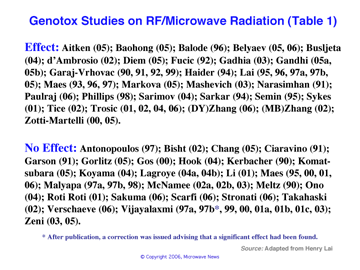
There is just about an even split between effect and no-effect papers. But look what happens when we superimpose the funding source for each study (where available): Those sponsored by industry are in red and those sponsored by the U.S. Air Force are in purple in Table 2. (Papers with no declared funding source are in green.)
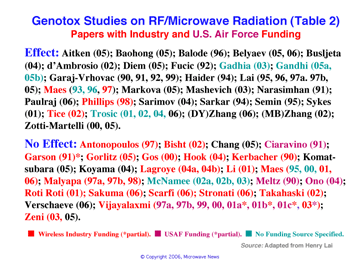
A clear —and disconcerting— pattern emerges: 32 of the 35 studies that were paid for by the mobile phone industry and the U.S. Air Force show no effect. They make up more than 75% of all the negative studies. You don't need to be a statistician to infer that money, more often than not, secures the desired scientific result.
One of the three industry studies that did find an effect nearly failed to make it into print. It was carried out by Jerry Phillips under a Motorola contract. Motorola opposed Phillips' decision to write up his positive findings and, according to Phillips, the company tried to stop him. Phillips resisted and succeeded, but it was the last piece of original EMF research he ever completed.
A similar loss of balance occurs when you look at only the papers published in Radiation Research. These are colored orange in Table 3.
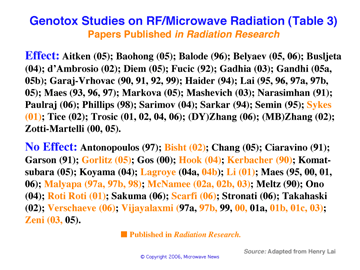
Over the last 16 years, only one positive paper on microwave genotoxicity has appeared in Radiation Research. During the same time, the journal has published 21 negative genotox papers. (Australia's Pam Sykes, the lead author of the lone positive paper, was denied money for a follow-up and soon moved on to other research areas.)
When Tables 2 and 3 are combined, you can see that 80% of the negative papers (17 out of 21) published in Radiation Research were paid for by either industry or the U.S. Air Force. These are in red in Table 4.

And of these 17, most are associated with a single lab: Joe Roti Roti's at Washington University in St. Louis. Roti Roti's principal funding source is Motorola. The 10 Roti Roti–Motorola papers on RF/microwave genotoxicity are in pink in Table 5.
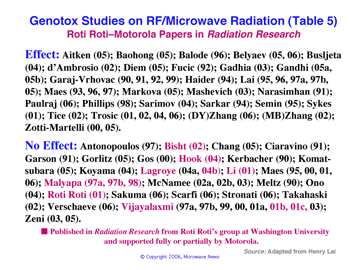
In addition, many other Roti Roti papers on other types of microwave effects, also paid for by Motorola, have been published in Radiation Research. With respect to microwave radiation, it almost appears as if Radiation Research is a house organ of the Motorola Corporation.
Who Picks the Peers for Peer Review?
Is it possible that all these imbalances can be explained by the fact that only sloppy studies show positive effects and that the superior peer review process at Radiation Research weeds out the chaff leaving only the well-controlled and well-executed negative studies fit for publication? The three editors suggest that this is so: "Negative studies are held to considerably higher standards than positive studies," they write.
To refute this line of argument one needs only to look at the now-infamous "dead-mice-walking" study by Tim Kuchel and Tammy Utteridge published in Radiation Research in 2002. That paper appears to have been rushed into print in order to nullify an earlier study, which found that microwaves could promote cancer in mice. (Motorola supplied the exposure equipment for the new experiment.)
As we commented when Kuchel's paper first appeared, it signaled a "massive failure of peer review" (see MWN, S/O02 p.19). There were many errors in the paper, but the most obvious and egregious one allowed two figures to appear on the same page in open contradiction to each other. Mice that were shown to have died in one figure were still being counted, picked up, and weighed in the other. Even Q. Balzano, a former senior Motorola executive, told us at the time that, "The paper is chock full of contradictions." Whatever its shortcomings, the Kuchel-Utteridge study continues to be touted by Motorola and Moulder as a key indicator that wireless radiation is harmless.
Peer review is only as good as the reviewers. A flawed paper can be published, if the supervising editor selects sympathetic reviewers who will be likely to overlook them. This is what appears to have been going on at Radiation Research.
John Moulder: Industry Consultant
We suspect that much of Radiation Research's bias against EMF effects can be attributed to John Moulder, who came on as an editor in 1991 and was promoted to senior editor in 2000. For this whole time —during which the microwave–genotox controversy became more and more contentious— Moulder has been a consultant to the power, electronics and communications industries, as well as for anyone, it seems, who disputes the existence of EMF-induced adverse health effects. For years he posted his skeptical views on the health impacts of cell phones, base stations and power lines on his Web site, and these serve as lures for potential like-minded clients.
Last year, for example, Moulder testified against the family of Richard Beissinger, a professor at the Illinois Institute of Technology (IIT) in Chicago who died of a brain tumor in 2003. His widow and five children were seeking worker's compensation for what they believed was an EMF-induced cancer. Beissinger taught and worked in rooms near electrical transformers. His magnetic field exposures are uncertain, but very high, ranging from 10 mG (1 µT) to 820 mG, and at times probably more than 1 G or 1,000 mG.
At a hearing held in 2005, Moulder stated under oath that, in his opinion, "power-frequency magnetic fields do not cause any kind of brain cancer under any exposure, intensity and duration" [our emphasis].
Moulder was no doubt aware that the California EMF program had previously concluded that magnetic fields are a likely cause of adult brain cancer. And that many years earlier, a team coordinated by the Electric Power Research Institute (EPRI) had reported that, taken together, epidemiological studies of workers exposed to magnetic fields pointed to a statistically significant elevated risk of brain cancer.
While electric utility industry operatives may have conceded that there may well be a link between long-term exposure to magnetic fields and brain cancer, that did not deter Moulder. He made $10,000-$12,000 trying to deprive the Beissinger family of a small pension. On May 23, at about the same time that the "negative effects" editorial appeared in Radiation Research, an arbitrator rejected Moulder's argument and ruled in favor of Beissinger's family. The decision is under appeal.
In the course of his testimony, Moulder acknowledged that he had earned approximately $300,000 in litigation-related fees, on power-frequency EMFs. This probably represents a fraction of Moulder's earnings, since litigation services represents only one part of his consulting practice. For instance, in 2001 Moulder testified at a hearing on behalf of the Minnesota Power Co. and Wisconsin Public Service Corp., which had applied to build a new transmission line. In that testimony, Moulder revealed that he would be paid about $35,000 for this case alone.
Nor is Moulder's consulting limited to power-frequency EMFs. In 1999, he prepared a report for the U.K. Federation of Electronic Industry (now called Intellect), which was submitted to the Independent Expert Group on Mobile Phones, better known as the Stewart panel. And the following year he wrote a report for the Australian Mobile Telecommunications Association, which was submitted to the Australian Senate. He has not disclosed how much money he was paid for these opinions, but in March 2001, Moulder told an Australian senate committee that, on average, 8-10% of his income was from the telecommunications industry alone.
Those Reporting Positive Results Attacked
Back in 2001 after Moulder had moved up to senior editor, he recruited Vijayalaxmi of the University of Texas in San Antonio to join the Radiation Research editorial board. A couple of years earlier they, together with some colleagues from Washington University and the U.S. Air Force, had published a review paper that dismissed any possible connection between cell phones and cancer. This too was published in Radiation Research.
As shown in Table 2, Vijayalaxmi is the lead author on seven of the microwave-genotox papers. All were funded by the U.S. Air Force, Motorola or a combination of the two.
Last year, while she was still an associate editor at Radiation Research (she stepped down soon afterwards), Vijayalaxmi together with Sheila Johnston, a long-time consultant to the mobile phone industry based in London, launched an aggressive assault against Lai and Singh and their work on genotoxicity. In an e-mail accompanying their analysis of Lai–Singh's research, Johnston wrote: "Lai's science has failed CONCLUSIVELY" [her emphasis]. The Vijayalaxmi–Johnston rant was so amateurishly written that it was largely ignored. What's harder to forget is the virulence of their attack. "They are not scientific statements," Singh told us at the time, "they are personal attacks. They do not want to solve problems, they want to eliminate us."
James McNamee of Health Canada in Ottawa is the new EMF specialist on the editorial board of Radiation Research. He has published three negative papers on microwave genotoxicity in Radiation Research. McNamee also has written a review paper with Moulder on cell phones and cancer.
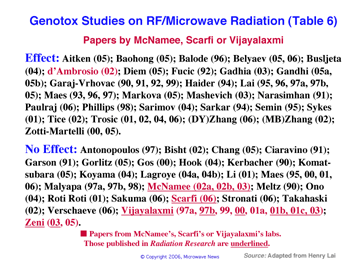
Earlier this year, Vijayalaxmi, McNamee and Maria Scarfi, a researcher based in Naples, Italy, wrote an angry letter to Mutation Research warning of the questionable nature of two positive genotox papers —one by Elisabeth Diem (Diem 05) of the University of Vienna and another by Sabine Ivancsits from the same lab on power-frequency EMFs. Vijayalaxmi, McNamee and Scarfi are authors on 14 of the 42 negative genotox papers, as well as one positive one. Ten of their 14 negative papers were published in Radiation Research, as shown in Table 6.
The microwave-genotoxicity controversy is a mean and nasty business, made meaner and nastier by the unrelenting attacks on those who dare claim that such effects do exist. But with John Moulder at Radiation Research, the playing field is hardly level, especially when the journal does not disclose its senior editor's ties to industries whose fortunes depend on assuring the public that microwaves have no effect whatever on DNA.
At a time when potential conflicts of interest among authors of medical and scientific papers are front page news (see, for instance, the July 11, 2006 Wall Street Journal on a paper published by the Journal of the American Medical Association), and more and more journals are requiring full disclosure of ties to industry, it is surprising —no, astonishing— that a leading radiation journal allows such obvious conflicts to remain unacknowledged. An editorial in the Sunday New York Times on July 23, said that the "best hope" for the credibility of medical journals is for them "to try much harder to find authors free of conflicts." Surely the situation is even worse when a journal's editor, who serves as the guardian charged with ensuring that contributors' potential conflicts are fully disclosed, is mired in his or her own conflicts.
What is it about EMF-health research that allows people to ignore the rules that govern other areas of biomedicine and public health? Why, for instance, did the World Health Organization turn a blind eye when told that Mike Repacholi was taking money from the wireless industry to pay for his EMF program in violation of the WHO rules? Was it really enough that Repacholi had engineered a scheme to launder the funds in Australia before they were forwarded to Geneva?
Similarly, Sara Rockwell of Yale medical school, the editor-in-chief of Radiation Research, and the officers of the Radiation Research Society, its publishers, must be aware of the conflicts posed by Moulder's extensive consulting for industry. Yet Rockwell had no qualms about signing Moulder's self-serving editorial, and none of them has felt the need to disclose Moulder's long-standing ties to industry.
Radiation Research has become a repository for negative papers and thus an important part of the industry and military strategy to neutralize those who dare to challenge the no-effects dogma. Their work had been made much easier with John Moulder on the inside to ease industry papers into print.
 Download a pdf of this commentary.
For the list of references, with their abstracts, click here.