

2024 Short Takes
Industry Sees Strict Standard as Barrier to 5G Development
Seeks To Bring It into Line with ICNIRP
This is a continuing story —with the most recent updates on top.
The International Commission on the Biological Effects of Electromagnetic Fields (ICBE-EMF) has written to Italian government officials to support the country’s strict 6 V/m RF exposure limit.
The letter, dated March 13, expresses “great concern” that the standard might be weakened. It is signed by Ronald Melnick, the chair of ICBE-EMF, and by Elizabeth Kelley, its managing director. Before his retirement, Melnick was a senior toxicologist at the U.S. NTP. He designed the NTP RF–cancer animal study.
The letter begins:
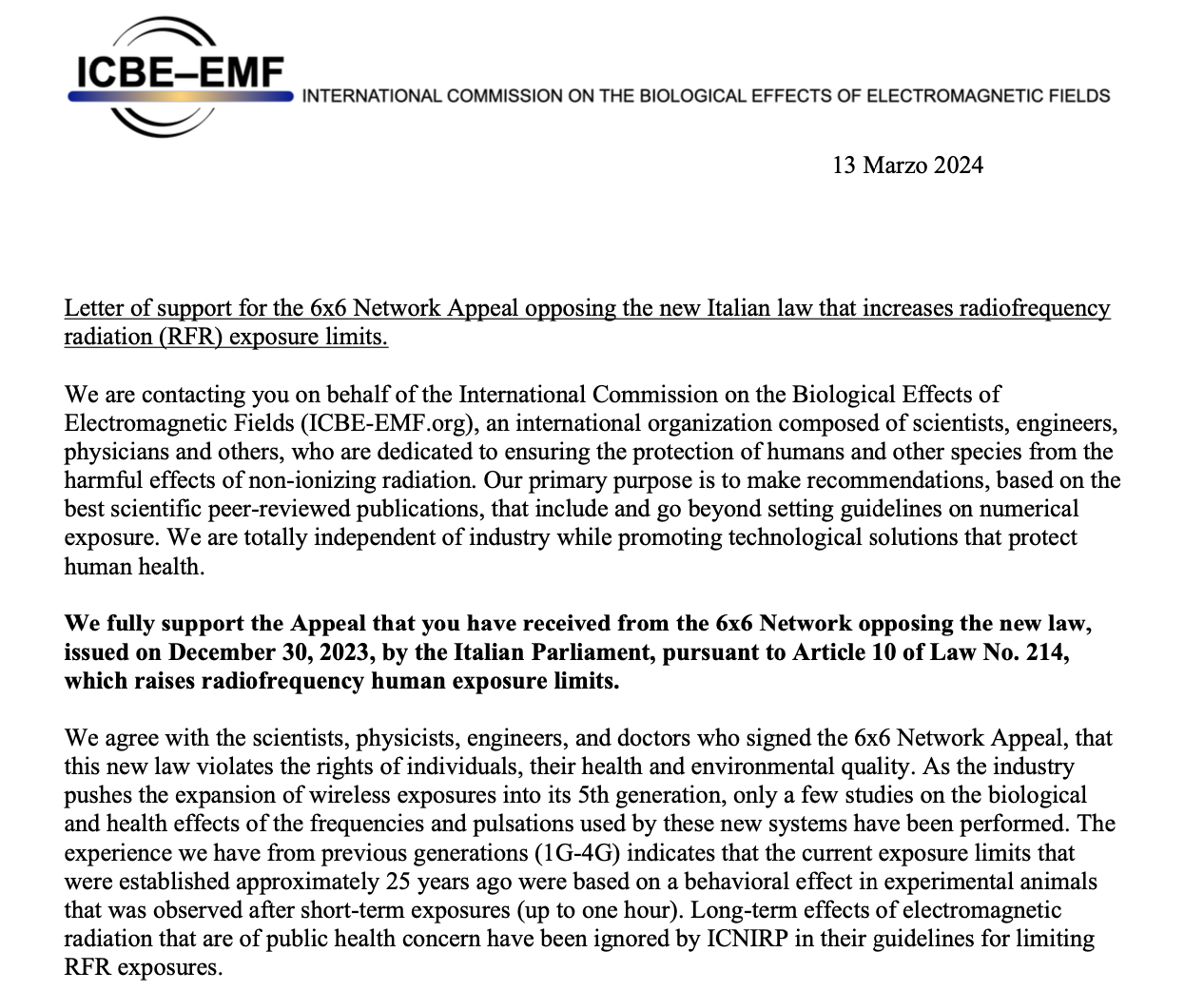
A full copy of the four-page letter is available in English and in Italian. See also the scientists’ appeal to keep the Italian limit, issued last August.
The ICBE-EMF was set up in March 2021, as a counterweight to ICNIRP, more here.
December 31, 2023
As the year comes to a close, the 6 V/m appears, once again, very vulnerable. Stay tuned as the situation plays out over the coming months.
August 9, 2023
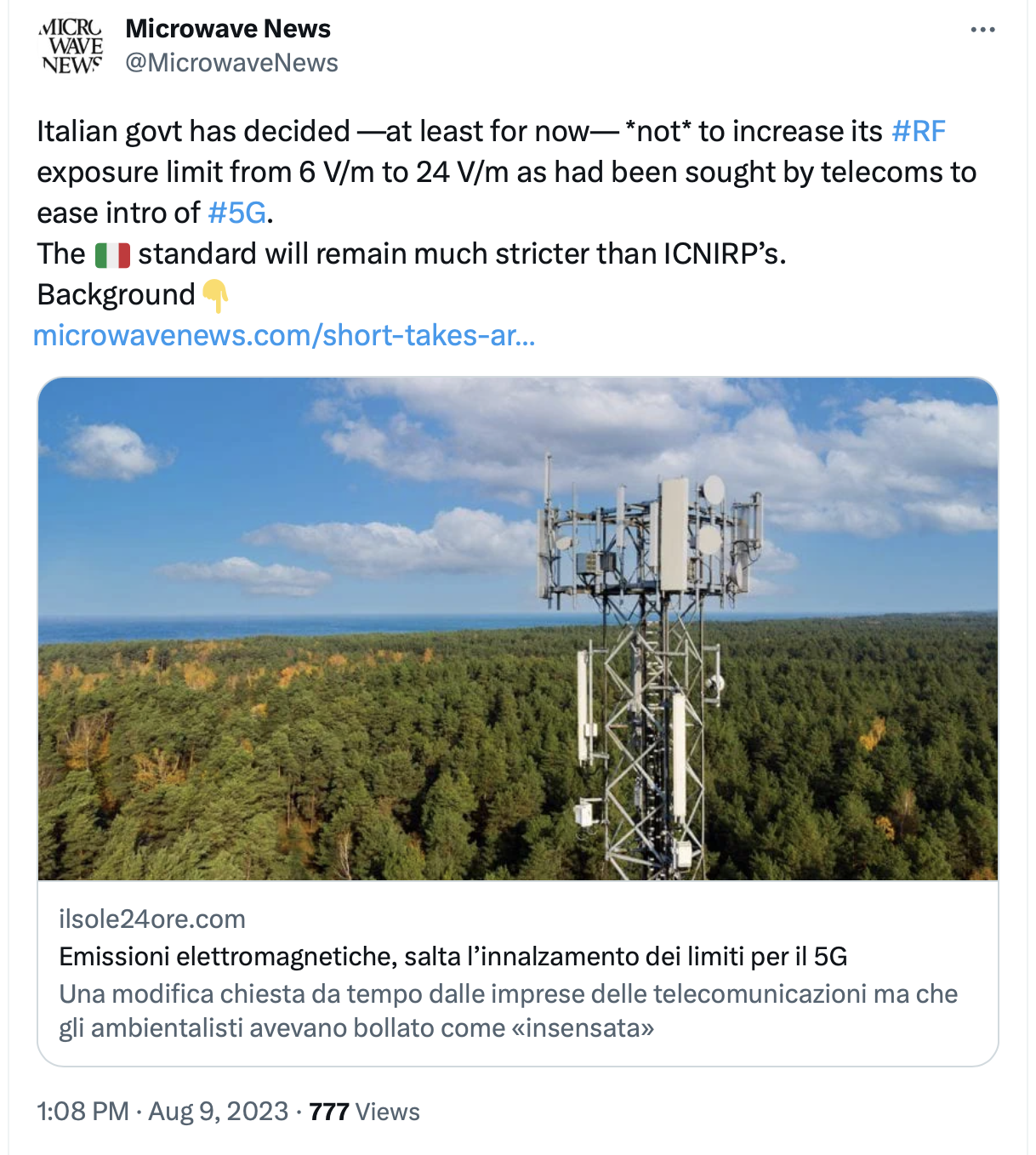
The Italian government has signaled that it intends to keep its strict 6 V/m RF radiation exposure limit.
 _______________
Below is our original story, posted more than two years ago, when the limit was first under pressure.
May 3, 2021
Italy’s 6 V/m RF exposure standard, one of the strictest in the world, may soon fall victim to 5G.
The Italian limit, adopted more than 20 years ago, is widely perceived as standing in the way of the build-out of 5G infrastructure, which will require the installation of many more RF antennas. The proposed solution is to make the standard ten times weaker and bring it in line with ICNIRP’s 61 V/m guideline.*
The standard is a target of Italy’s post-pandemic national recovery plan (known as the Next Generation Italia or PNRR). The plan allocates over €40 billion (~US$48 billion) to advance the digitization of the country, including promoting 5G technology and increasing broadband speeds nationwide, currently among the slowest in Europe.
All the major political parties, except one, favor loosening the 6 V/m limit, according to La Repubblica, the second most widely read (non-sport) newspaper in Italy. The one holdout is the Fratelli d’Italia party (Brothers of Italy), a far-right, neo-fascist group —and even it is on record as wanting to make the siting of antennas easier for telecom operators.
The proposal has galvanized a coalition of Italian environmental researchers and activists, as well as members of the international RF research community. They have appealed to the government to save the 6 V/m limit. (See Tweets below.)
One appeal, sent to Mario Draghi, the recently installed prime minister, on April 26, had been signed by more than 8,700 supporters within a couple of days, according to Fiorella Belpoggi. She is the scientific director of the Ramazzini Institute in Bologna and is helping coordinate the campaign.
Italy has long been a hotbed of anti-5G activism. A petition calling for a moratorium on 5G, launched two years ago, has garnered more than 63,000 signatures. The Italian Stop 5G Alliance has been a major force in promoting this petition.
The protests —including a hunger strike by over 150 people— appears to have softened the government’s approach. When the lower house of the Parliament approved the recovery plan at the end of April, the proposal to eliminate the 6 V/m limit had been dropped and replaced by a call to review the standard.‡ But, Belpoggi told Microwave News, “the door for a change remains open.”
All Eyes on Vittorio Colao
Much of the public furor at the potential weakening of the exposure limit has been directed at Vittorio Colao, the Harvard-educated minister for innovation, technology and digitization in the new Draghi government.
Colao was the chief executive of Vodafone, the largest telecommunications company in Europe, for ten years, ending in late 2018. The following year he became a director of Verizon, the second biggest telecom in the world (after AT&T) and, like Colao himself, a major promoter of 5G technology. Colao has now stepped down from the Verizon board. He has been praised as a “strategic visionary.”
Colao played a major role in designing the PNRR. He was commissioned by the previous Italian prime minister, Giuseppe Conte, to devise a post-COVID recovery strategy, which became known as the Colao plan. It included investments in infrastructure.
That plan, delivered to Conte last June, proposed raising Italy’s exposure limits to those recommended by the EC† (that is, the ICNIRP limits), according to Livio Giuliani, the former director of research at Italy’s National Institute for Prevention and Occupational Safety (ISPESL, now INAIL). The 2020 plan‡ also favored giving national authorities the right to veto local ordinances that block antennas.§ (This would be similar to the federal preemption of local laws in the U.S.)
The new digitization initiative, which Colao would most likely implement, accounts for about 20% of the total outlays under the €200 billion PNRR.
In a meeting with legislators in April, Colao acknowledged that a weakening of the 6 V/m limit is “unpopular.” He committed to striking a balance between the number of antennas and the health and welfare of the citizenry, pledging that, “the scientific evidence would be evaluated,” according to La Repubblica.
When the 6 V/m standard took effect in 1999, Italy had the most restrictive standard in Europe. A year later, Switzerland adopted a 4 V/m limit for cell tower radiation and a 3 V/m limit for radio and TV transmitters (details here).
The 6 V/m limit is approximately the same as the Soviet/Russian exposure standard of 10 μW/cm2.
It is not clear what impact the Italian standard may have had on the build-out of the mobile phone network or would have on 5G antennas.
The April 26 appeal to Draghi concludes:
“Italy has led the world for the last 20 years in demonstrating that their lower and more health protective exposure limits for RFR can be reached by the Italian Telecommunications industry without significant economic or technical barriers to their expansion into 4 and 5G systems.”
___________________
Here’s a thread of Microwave News Tweets, posted last week as some of this story played out:
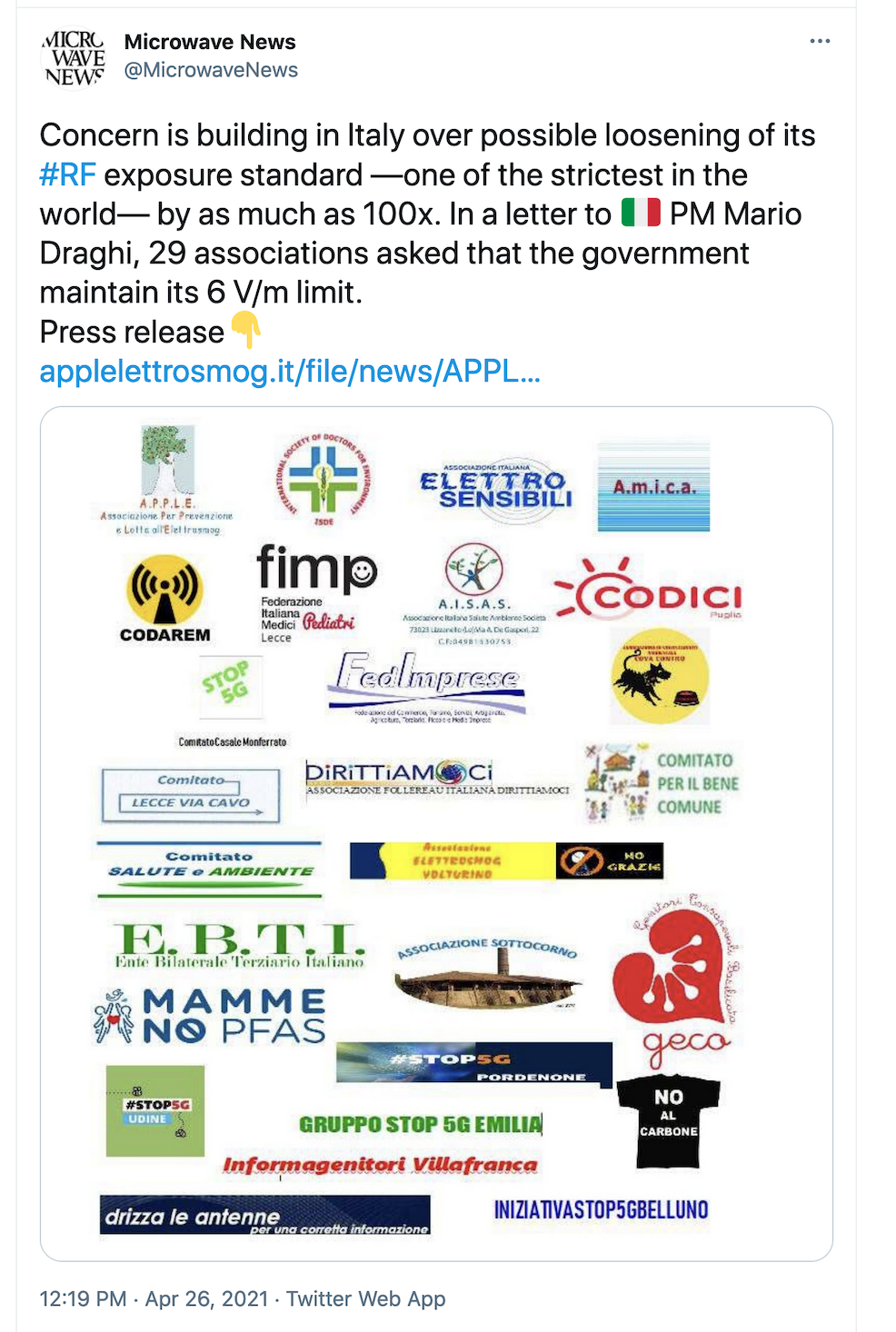 Link to press release
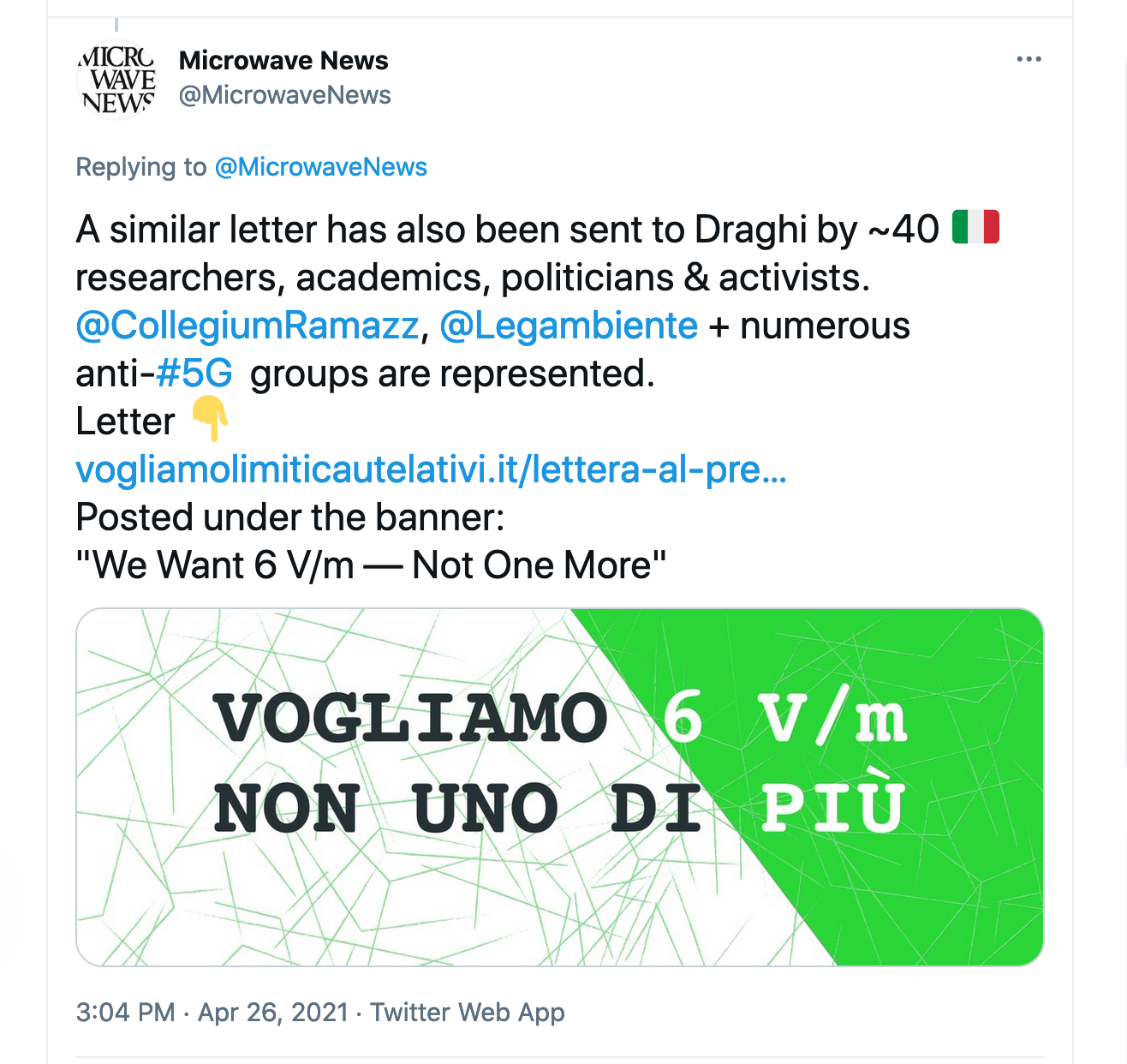
Link to letter

Link to letter

______________________
* How much weaker is the ICNIRP standard than Italy’s 6 V/m limit? It depends on whether you are looking at the electric field or power density. The 6 V/m electric field standard is approximately ten times stricter than ICNIRP’s 61 V/m. In terms of power density, the Italian limit is about a hundred times stricter than ICNIRP (10 μW/cm2 v. 1 mW/cm2). The reason: Power density is proportional to the square of the electric field strength.
† In 1999, the EC recommended that member states follow the ICNIRP guidelines. From the Italian Parliament on March 24, 2021: “Consider adjusting the current Italian limits on electromagnetic emissions to the European ones.” (Item #15 on p.76.)
‡ See also the July 2020 report on 5G from a committee of the Italian Parliament.
§ See item #27 on p.22 of the June 2020 Colao plan. Some 500 municipalities have policies that make it hard to site antennas, La Repubblica reported last year.
Prof. Katsumi Imaida To Present at Tox Meeting in Utah
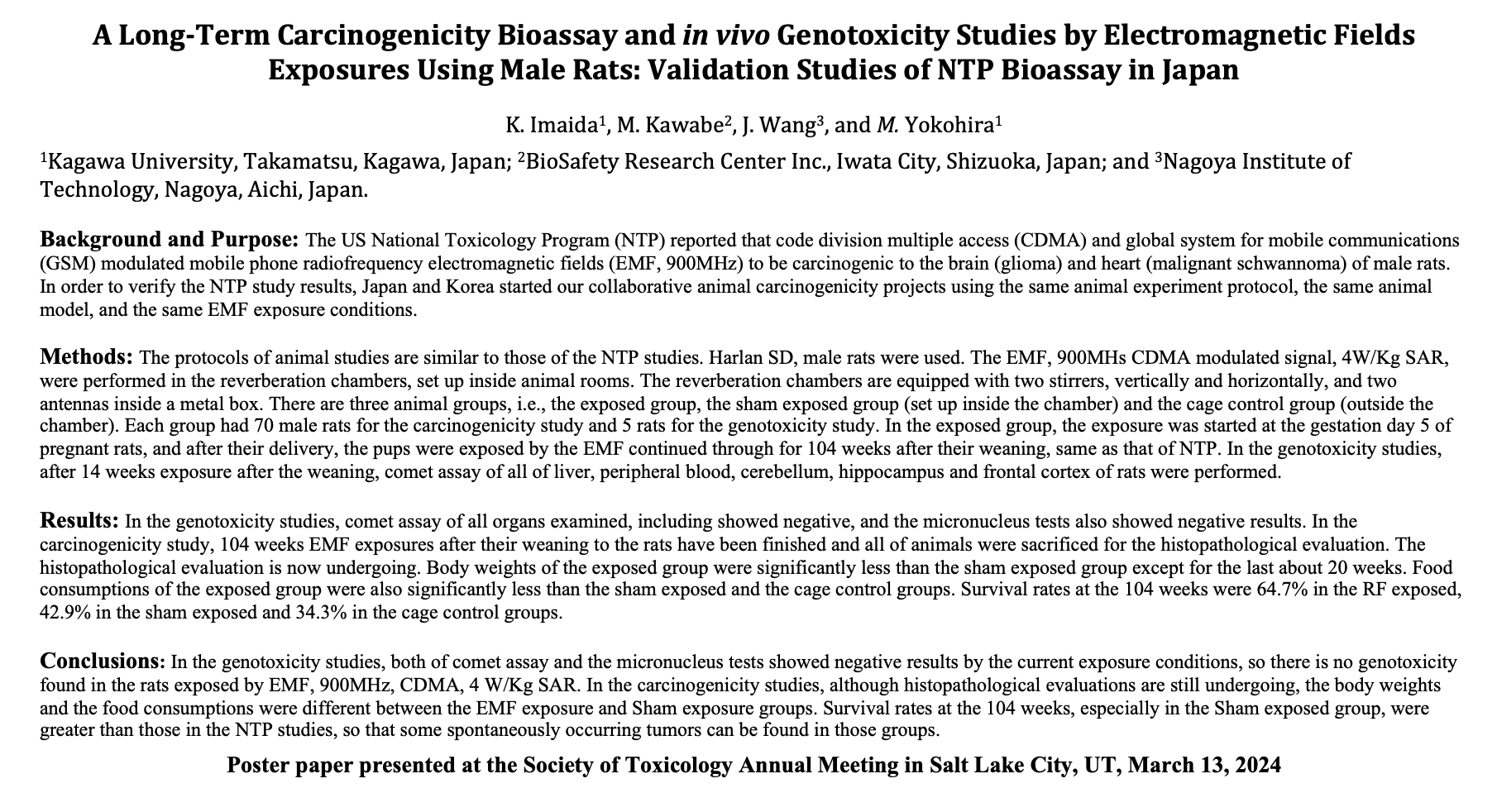
The Japanese group running a partial repeat of the NTP RF cancer study has not observed genotoxic effects among male rats exposed to 900 MHz CDMA radiation at 4 W/Kg, according to a paper to be presented tomorrow at the annual meeting of the Society of Toxicology in Salt Lake City, UT (SOT2024).
The genotox studies were carried out following 14 weeks of RF exposure.
The analysis of the cancer data is ongoing and will not be reported.
Among the long-term results reported by the Japanese team:
• Body weights and food consumption of the exposed rats were significantly different from the controls.
• After two years, more of both the exposed and control rats in Japan had survived than in the NTP experiment. This was “especially” noteworthy for the controls.
Professor Katsumi Imaida of Kagawa University in Takamatsu, the lead author of the paper, is scheduled to present these results at the SOT meeting. They are essentially the same as those he presented at the BioEM2023 meeting last June in Oxford, England.
A parallel project is also ongoing in Korea and the data from each will be pooled to improve the statistical reliability of the results. The Japanese/Korean animal study is a scaled-down repeat of the $30 million study by the U.S. National Toxicology Program (NTP), which found clear evidence that RF radiation can cause cancer. The Asian study has been dubbed “NTP Lite”. The project is being called a “validation” study.
In contrast to the Japanese findings, the NTP team did see DNA breaks (NTP paper here). Both U.S. and the Japanese groups used the comet assay, developed by N.P. Singh.
Last June, Young Hwan Ahn, the leader of the Korean project team, presented his own status report at a private briefing for the WHO EMF Project in Geneva. At the time, he revealed that the Korean genotox experiments had to be delayed due to the unexpected death of four RF-exposed rats early in the two-year experiment.
For more on the joint Japanese/Korean project, see Ahn and Imaida’s 2022 paper in Bioelectromagnetics (open access).
Members of the project’s international advisory committee are: Alexander Lerchl, Michael Repacholi, Emilie van Deventer, Eric van Rongen, Vijayalaxmi, Joe Wiart and Michael Wyde.
_____________________________
Prof. K. Imaida’s Poster Paper at SOT 2024 in Utah, March 13, 2024
 Click to enlarge.